
Exhibit A -- Specifics of the Loan
Open to Nationwide Accredited Investors ONLY
Loan Number: N2918
Loan Amount: $300,000
Minimum Investment: $10,000
Call for availability of smaller participations
Type: First Mortgage
Yield: 11.0%*
Target Closing Date: August 31, 2026
Important Links:
How to Invest in This Loan
Suitability Requirements
Private Placement Memorandum
Loan Servicing Agreement
Audited Financial Statement for B & S
Inventory of Available Loans
To Be Added to Our Investor Email List
PROPERTY
Project: Schenectady NY Rehab
Property Address: 2116 & 2120 Broadway,
Schenectady, NY 12306
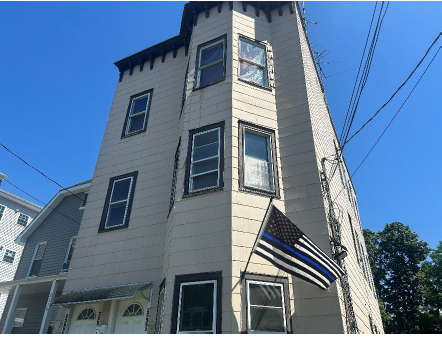
Description: The subject property consists of two buildings on a single parcel. The two properties include one 3-unit residential property and one 1-unit commercial property, totaling 6,171SF on a 0.28-acre lot located in the City and County of Schenectady, NY.
For an aerial view of this property...Click Here!
For a street view of this property...Click Here!


TERMS
Term of Investment |
12 months |
Current Interest Rate |
11.0%* |
Repayment Schedule |
Interest Only |
Monthly Payment |
$2,750* |
Purchase Price of the Note |
$300,000 |
Current Balance on the Note |
$300,000 |
Maturity Date |
12 months |
Balloon Pymt. after 60 months app. |
$303,225 |
Late Charge Amount |
$275** |
Prepayment Penalty |
None |
| Construction Holdback | $200,000 |
| 12-Month Payment Reserve | $38,700 |
*Net of servicing
**To be shared equally with B&S
EQUITY ANALYSIS
Appraised Value - June 9, 2026 |
$360,000 |
Appraised Value - ARV |
$710,000 |
Protective Equity - AS-IS |
$60,000 |
Protective Equity - ARV |
$410,000 |
| Loan-to-Value - AS-IS | 83.3% |
| Loan-to-Value - ARV | 42.3% |
OPERATING STATEMENT
| INCOME | |
Rental Income |
$104,745 |
Vacancy Allowance (5.0%) |
$5,237 |
Effective Gross Income:
|
$99,508
|
EXPENSES |
. |
Property Taxes |
$15,982 |
Insurance |
$3,200 |
Utilities |
$3,000 |
Repairs & Maintenance |
$3,000 |
| General/Administrative | $1,500 |
Management |
$4,975 |
Reserves for Replacement |
$750 |
Total Expenses |
$32,407 |
NET OPERATING INCOME |
$67,101 |
BORROWERS
Name(s) |
Individuals |
| Net Worth | $754,271.11* |
| His Occupation | Insurance Salesman |
| Her Occupation | Customer Service |
| 2025 Adjusted Gross Income | $32,620 |
| 2024 Adjusted Gross Income | $100,377 |
| Percent Ownership | 100% |
|
|
|---|
To invest, please call Justine Smith |
SCHENECTADY NY REHAB
George Says: "This looks like a nice little loan. I like it."
Blackburne & Sons is pleased to present this first mortgage secured by two properties - one 3-unit residential building and one single-unit commercial commercial building - totaling 6,171SF on a 0.28-acre lot located in the City and County of Schenectady, New York.
The purpose of this loan is to finish renovating the subject property. It will include a 12-month payment reserve in the amount of $38,700 and a $200,000 construction hold back.
COUNTY INFORMATION
Schenectady County is a county in eastern New York’s Capital District, with Schenectady as its largest city, known for its rich history, diverse economy, and strong ties to technology and manufacturing. In 2025 the estimated population was 162,581. The county seat is Schenectady, which makes up about 41% of the county's population.
According to the U.S. Census Bureau, the county has a total area of 209 square miles, of which 205 square miles are land and 4.9 square miles are water. Schenectady County is in the U.S. state of New York. The County is part of the Albany-Schenectady-Troy, NY Metropolitan Statistical Area, and is west of the confluence of the Mohawk with the Hudson River. It includes territory on the north and the south sides of the Mohawk River.
CITY INFORMATION
Schenectady is a city in Schenectady County, New York, United States, of which it is the county seat. As of the 2020 census, the city's population of 67,047 made it the state's ninth-most populous city and the 25th-most populous municipality. The city is in eastern New York, near the confluence of the Mohawk and Hudson Rivers. It is in the same metropolitan area as the state capital, Albany, which is about 15 miles southeast.
In 2024, the median property value in Schenectady, NY was $168,800, with a home ownership rate of 45.6%, and the median household income was $58,399. The economy of Schenectady, NY employs 31.3k people. In 2024, the largest industries in Schenectady, NY were Health Care & Social Assistance (5,181 people), Retail Trade (3,911 people), and Educational Services (3,553 people), and the highest paying industries were Utilities ($80,600), Finance & Insurance ($73,187), and Professional, Scientific, & Technical Services ($72,310). The largest universities in Schenectady, NY by number of degrees awarded are Union College (527 and 49.2%), Schenectady County Community College (325 and 30.3%), and Paul Mitchell the School-Schenectady (90 and 8.4%).
SUBJECT PROPERTY DETAILS
The subject site consists of a single parcel that is generally rectangular in shape and level in topography. It contains 0.28-acres and has minimal landscaping. The subject neighborhood is a mix of residences and smaller-scale retail and service uses which serve the adjacent neighborhood as well as Citywide clientele.
The site is improved with a class C construction, 3-unit residential property and one 1-unit commercial property that was originally built in 1903. It is split across two buildings with one building containing the three residential units and the other containing the one commercial space. The residential units consist of a mix of two and three-bedroom units, with an average unit size of 900SF along with a separate commercial use 1-story building.
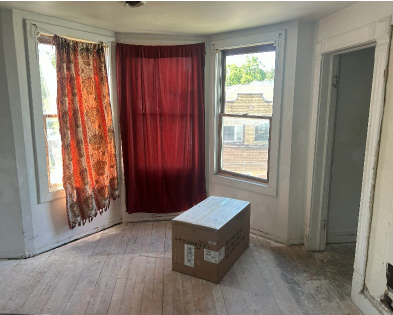
The borrowers purchased the subject property in January 2025 for $325,000. Since then, they have put roughly $136,000 into the property for kitchen and bathroom demolition, garbage removal and new appliances. The property is currently vacant and undergoing a complete renovation.
The borrower plans to use this loan to complete roughly $180,000 worth of renovations between the two subject buildings. Each residential unit will receive about $40,000 in repairs, and the commercial building will receive $60,000. The loan has a $200,000 holdback and an interest reserve built in to cover all payments for the duration of the loan. Improvements to the properties will include new plumbing, flooring and paint for the three residential units. There will also be updates to the kitchens and bathrooms. The commercial unit will be getting new paint, installation of updated appliances and furnace, drywall, and electrical upgrades.
BORROWER SUMMARY
The borrowers are a married couple who hold title to the property personally. They work as an insurance salesman and in customer service. They reported an adjusted gross income of $32,620 in 2025 and $100,377 in 2024. The reason for the drop in income for 2025 was due to a transition period when borrowers moved cities. They have mid-credit scores of 734 and 516 and self-reported net worth of $754,271.11.
VALUATION SUMMARY
We hired an MAI appraiser who valued this property at $360,000 (AS-IS) and $710,000 (After Rehab Value) . We also hired a broker to perform a Broker’s Price Opinion (BPO) who valued the property at $440,000 (AS-IS). It should be noted that this AS-IS value inlcudes both buildings.
At an 11.0% yield to investors and an 83.33% LTV (AS-IS) and 42.25% LTV (ARV), this appears to be a reasonable investment. Investing in any first mortgage involves substantial risk, so be sure to read the Risk Factors section of the Offering Circular carefully before investing. A large and prolonged decline in real estate values is possible. Foreclosed commercial properties almost always need to be renovated before they can be leased or sold, so be sure to maintain some liquidity.
ACCREDITATION STANDARDS
Please note this offering is a SEC Regulation D filing and will be done through a Private Placement Memorandum. In order to invest, you must be an accredited investor. Generally speaking, an accredited investor is an individual:
(a) whose individual income exceeds $200,000 in each of the past two years, with reasonable expectation of reaching the same going forward OR
(b) whose joint income with spouse exceeds $300,000 in each of the past two years OR
(c) your NET WORTH exceeds $1,000,000 (exclusive of your primary residence) OR
If you plan on investing through an entity, the entity can qualify if ANY of the following are met:
(a) all equity owners must be accredited OR
(b) any trust with more than $5,000,000 in assets OR
(c) ERISA with either $5,000,000 in assets OR a bank, insurance company, or registered investment advisor as it's trustee OR
(d) any self directed ERISA with an accredited investor(s) making the business decisions OR
(e) an IRA owned by an accredited investor
George’s Advice For Successful First Mortgage Investing
- You should spread your mortgage investment portfolio out among lots of different deals. If you have $300,000 to invest, you should invest $10,000 to $20,000 in 15 to 20 different fractionalized first trust deeds. For example, if the deal is a $300,000 first trust deed on an office building in Boise, with a $15,000 investment you would own 5% of the loan. By spreading your money out into a bunch of different deals, you are achieving the diversity of a fund without the failed fund sponsor problem. If you are extremely wealthy, you could double (or even triple) my suggested investment amounts, but be careful about pouring too much money into a single deal. We once had a whole building fall into an old coal mine. Ouch.
- Be wise and resist investing in any first trust deed yielding more than 9%. I would personally never invest in a first trust deed with a double-digit yield. The payments slowly grind the borrowers into the dust.
- Blackburne’s Law theorizes that a portfolio of 8% and 9% first trust deeds will outperform a portfolio of 11% and 12% first trust deeds over a seven-year term. Only our wisest (and eventually the happiest) investors listen to me.
- You can also buy some of our smaller deals in their entirety, but I only recommend this if you are richer than Crassus.
- It is very easy to lose money in hard money first mortgages, so fight-fight-fight against the temptation to invest in high-yield deals. As Nancy Reagan used to say, “Just say no.” But if you choose 7% to 9% first mortgages, I predict that you will be very, very pleased.
- During the S&L Crisis, commercial real estate fell by 45%. Within three years of hitting bottom, values reached new highs. During the Dot-Com Meltdown, commercial real estate fell by 45%. Within three years of hitting bottom, values reached new highs. During the Great Recession, commercial real estate fell by 45%. Within three years of hitting bottom, values reached new highs. Some time in the next decade, we will have another opportunity to snatch up prime commercial real estate at a huge discount. You will be terrified, but when Blackburne and Sons invites you to join a syndicate to buy a nice commercial property at a 35% discount off its prior high, just remember that the best time to invest is when blood is running in the streets. Why not when real estate has fallen by 45%? You’ll never catch the very bottom because historically the bounces off the bottom happen much too fast. Bounce-soar. You will be terrified, but just remember that the best time to invest is when blood is running in the streets.
Earn a $250 Referral Fee |
To invest, please call Justine Smith |
Blackburne & Sons Realty Capital Corporation--For more information, contact Justine Smith
555 University Ave., Suite 150, Sacramento, CA 95825
Telephone: (916) 338-3232 * Fax: (916) 338-2328
Real Estate Broker -- California Department of Real Estate -- License Number 829677 -- NMLS Number 103430
Publicly advertised to California residents only under California Department of Business Oversight business plan permit.
Return to C-Loans Home Page | Return to Blackburne & Sons Home Page
Copyright © 2026 Blackburne & Sons Realty Capital Corporation. All rights reserved. (800) 606-3232